

Tattoo knowledge
The tiger and the dragon: their significance in Japanese art and tattoos
Nov
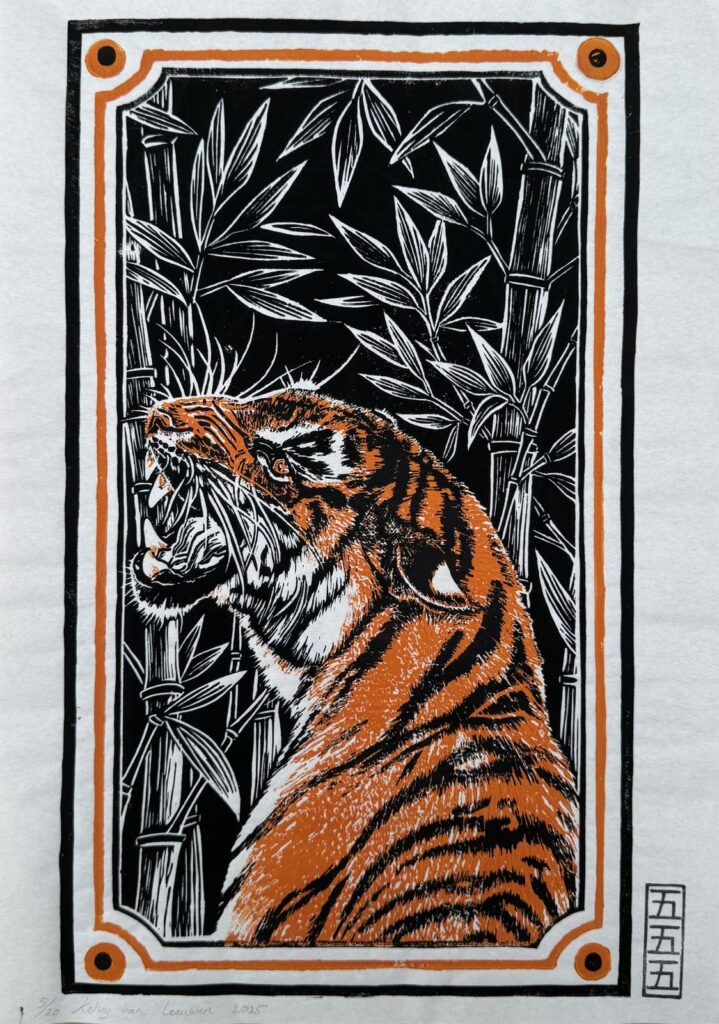
In Japanese art, the tiger symbolises strength, courage and protection, whilst the dragon represents wisdom, water and the power of nature. Together, they form a classic duo: two opposites that keep each other in balance. You can see them in woodblock prints, temple paintings and traditional Japanese tattoos, as well as in Kelsey’s linocuts.
The tiger
Tigers did not live in Japan. Japanese artists were mainly familiar with them through Chinese and Korean art and depicted them based on tradition. This is reflected in the stylised, sometimes almost fantastical tigers found in old paintings. The tiger symbolises strength, courage and a long life, and was regarded as a protector against evil spirits and illness. It is often depicted with bamboo or wind, the element over which, according to tradition, it reigns.
The dragon
The Japanese dragon, ryū, is descended from the Chinese dragon, lóng, and is different from the European dragon. It is not a fire-breathing monster, but a benevolent creature that rules over water: rain, rivers and the sea. It symbolises wisdom, strength and good fortune. Japanese dragons have a long, serpentine body and are often depicted amidst clouds or waves.
Tiger and dragon together
The tiger rules over the wind and the earth, the dragon over water and the sky. Together, they symbolise the balance between opposites, much like yin and yang. In tattoos, you often see them facing each other on two arms, on the front and back, or together in a single large design on the back.
Fixed combinations
- Tiger with bamboo: strength and resilience. Bamboo bends but does not break.
- Tiger with a peony: strength combined with prosperity. Read more about the the meaning of the peony.
- Dragon with clouds or waves: the dragon in its element.
From linocut to tattoo
The visual language of Japanese woodblock prints translates well to linocut: strong contours, flat areas and rhythmic lines. Kelsey’s prints Guardian Tiger and Kù Lóng, a Chinese dragon, illustrates this. If you’d like a tiger or dragon tattoo, a print like this could serve as a starting point for your own design. In black and grey, it looks great with bold outlines and shading.
What should you look out for?
Tigers and dragons need space. A dragon with a long body looks best when it can move in tandem with an arm, a leg or the back. A small tiger is possible, but only as a head or a stylised figure, not as a full scene.
Frequently Asked Questions
What does a tiger tattoo mean?
In Japanese tradition: strength, courage and protection against evil and illness.
What does a Japanese dragon tattoo mean?
Wisdom, strength and happiness. The Japanese dragon rules over water and is regarded as benevolent.
Can a Japanese tiger also be in black and grey?
Yes. Traditional Japanese designs are often in colour, but they look just as striking in black and grey with strong outlines and shading.
Fancy having a tattoo designed by Kelsey? Tell us about your idea, the location and the size in the application form. Kelsey attends sessions during the day and replies by email.