

Tattoo knowledge
Mandala tattoo: meaning, design and the best places
Nov
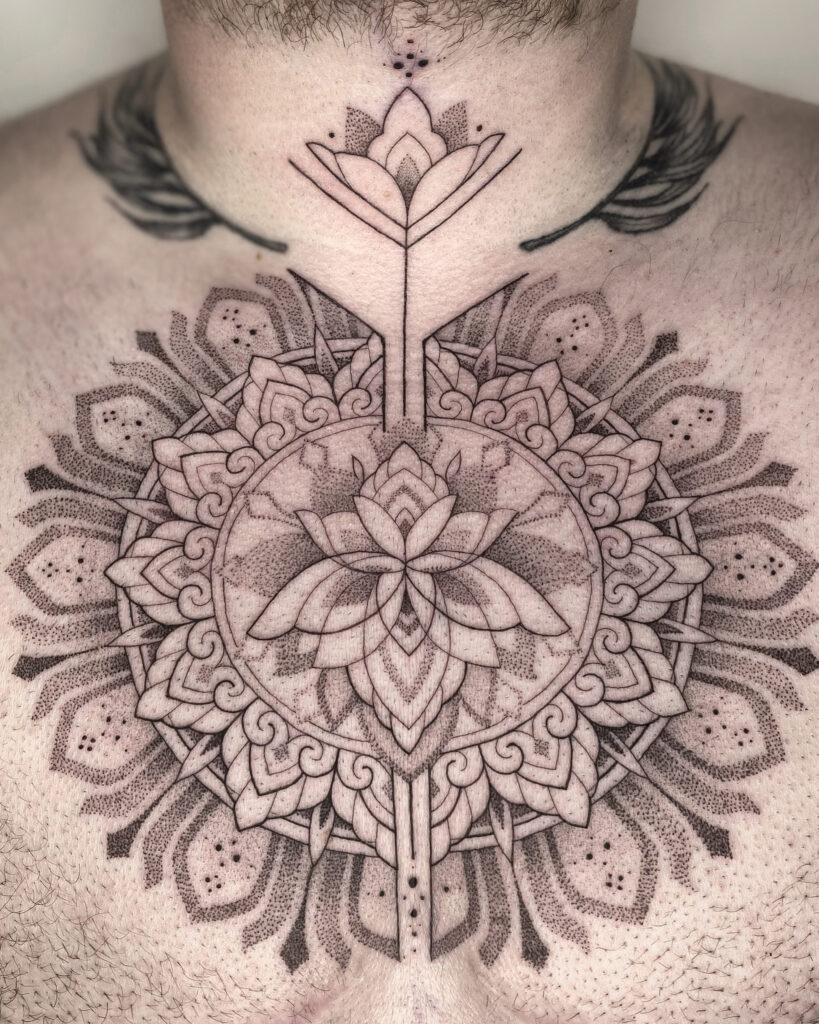
A mandala is a circular, symmetrical pattern that is constructed from the centre outwards. The word comes from Sanskrit and literally means “circle”. In Hinduism and Buddhism, the mandala is an aid to meditation and a representation of the cosmos. As a tattoo, it symbolises balance, wholeness and tranquillity for many people.
Where does the mandala come from?
Mandalas originate from the Indian and Tibetan traditions. Tibetan monks, for example, create them using coloured sand, only to sweep them away once they are complete: a lesson in impermanence. The design revolves around a central point from which everything radiates outwards symmetrically. This is what makes the mandala so visually powerful.
What does a mandala tattoo mean?
There is no fixed meaning. What people usually see in it:
- Balance and wholeness: Everything revolves around a single focal point.
- A new beginning or the end of a chapter: the circle as something that is complete.
- Calm and focus: The repetition in the pattern has a calming effect.
Many mandala tattoos are simply a reflection of a love for the pattern itself. That’s just as good a reason.
Mandala, ornamental and dotwork
A simple mandala is a circle. Ornamental work uses the same visual language, but follows the contours of your body: an ornament on the sternum, along the spine or around a joint. Dotwork is the technique: shading built up from individual dots rather than filled-in areas. This creates a soft, grainy transition that suits the refined character of a mandala.
Lotus flowers, crescent moons and Japanese motifs are often combined with a mandala. Read more about the the meaning of flowers in tattoos.
Which places work well?
- Forearm and upper arm: a single mandala or a half-mandala that wraps round the arm.
- Shoulder and shoulder blade: A round mandala drapes beautifully over the shoulder.
- Sternum and chest: A piece of jewellery that follows the symmetry of your body. It is, however, a sensitive area.
- Back: large enough for a complete composition.
- Knee and elbow: a mandala as a “cap” over the joint.
What should you look out for?
Symmetry is unforgiving. A mandala must be perfectly round and centred, even on a body that isn’t flat. That’s why, on the day itself, the design is applied to your skin using a stencil and checked whilst you’re standing, in the position from which you’ll see the tattoo most clearly. Size matters too: the more rings and detail there are, the larger the mandala needs to be to remain legible.
Frequently Asked Questions
Is a mandala tattoo culturally significant?
The mandala has religious origins. If you wish to respect that significance, choose your design carefully and avoid specific religious figures if you are unfamiliar with the background.
Can a mandala be small as well?
Yes, but with fewer rings and less detail. A small mandala with too much detail will become clogged after a few years.
How long does it take to get a mandala tattoo?
That depends on the size and the amount of dotwork. A large mandala may require several sessions.
See examples on the page mandala tattoo in Zaandam.
Fancy having a tattoo designed by Kelsey? Tell us about your idea, the location and the size in the application form. Kelsey attends sessions during the day and replies by email.